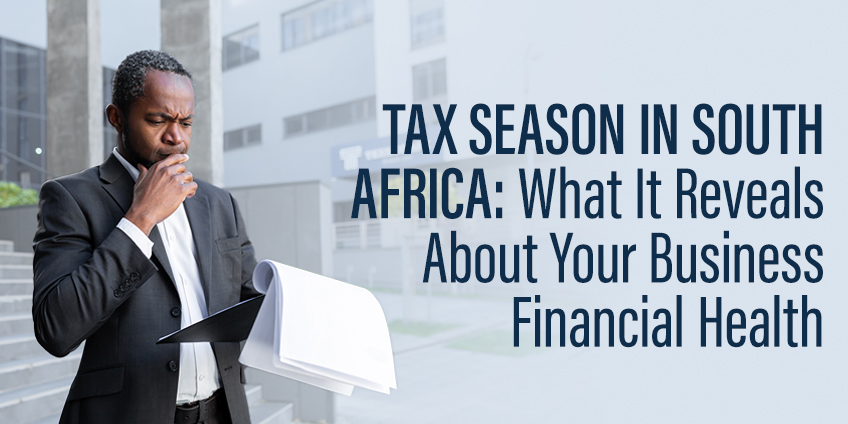
Tax season is often handled as a compliance deadline that’s made up of a period of submission, reconciliation and administrative pressure. This season often comes with the sighs, the scrambling for receipts and the group chat message that reads "does anyone have last March's invoices?"
However, for businesses operating in South Africa, tax season is far more than a regulatory requirement.
It's an annual check-up and like any check-up, you can either walk in prepared or walk in hoping nobody asks too many questions.
It reveals how well a business understands its financial position, how effectively it manages records and whether its operational decisions align with long-term sustainability. For decision-makers, tax season isn't just about what's owed to SARS. It's about what your numbers are quietly trying to tell you the other eleven months of the year.
Tax submissions require a complete and accurate reflection of a business's financial activity from revenue and expenses, to payroll obligations and asset performance. In practice, this means tax season becomes a mirror of financial discipline.
Businesses with structured financial systems typically experience smoother tax cycles. Their records are up to date, expenses are categorised correctly and liabilities are anticipated well in advance. In contrast, businesses with fragmented or reactive financial processes often experience delays, corrections and unexpected liabilities.
In South Africa, this is particularly relevant due to the layered tax environment governed by the South African Revenue Service (SARS), which includes income tax, PAYE, provisional tax and VAT obligations depending on business structure and turnover [1].
The more complex the tax position, the more important financial visibility becomes. There's no autopilot setting here, the businesses that win are the ones that plan ahead.
Across industries, tax season consistently surfaces operational and financial weaknesses that stay hidden during the day-to-day hustle. It's the moment the cracks in the foundation finally show up on the surface. These include:
These issues rarely emerge in isolation. Instead, tax season bundles them all together and hands you the invoice at once; making inefficiencies more visible and often more costly.
For example, provisional taxpayers are required to estimate taxable income and make advance payments throughout the year. When those estimates miss the mark, businesses are often faced with unexpected liabilities that disrupt operational cash flow [2]. A small miscalculation in March can turn into a very uncomfortable conversation in November.
Good numbers make good decisions possible and shaky ones make every decision a gamble.When financial systems are weak, decision-making becomes reactive, increasing exposure to penalties, misreporting, and missed strategic opportunities. When systems are strong, tax season becomes a structured review process rather than a period of financial uncertainty. One path feels like firefighting, while the other feels like foresight. Financial discipline here isn't only about meeting tax deadlines. It's about ensuring business decisions are backed by accurate, timely and structured financial data.
In South Africa's regulatory environment, where compliance requirements vary across business types and income structures, financial discipline is a key differentiator between businesses that scale sustainably and those stuck in a in a loop of recurring compliance pressure.
Tax season provides measurable signals about the state of a business (think of them as your company's vital signs). Key indicators include:
These indicators help determine whether a business is operating with proactive financial governance or reactive compliance management.
Tax season isn't only a compliance requirement. It's a reflection of how well a business understands and manages its financial health.
For organisations in South Africa, where regulatory expectations are layered and evolving, tax season offers a critical opportunity to assess internal systems, strengthen financial discipline and improve long-term operational resilience.
References
1 South African Revenue Service (SARS), “Income Tax Guide for Individuals,” 2025.
https://www.sars.gov.za
2 South African Revenue Service (SARS), “Provisional Tax Explained,” 2024.
https://www.sars.gov.za
3 South African Institute of Taxation (SAIT), “Tax Compliance and Business Governance in South Africa,” 2024.
https://www.thesait.org.za

Protect your business with innovative solutions.